Dating
The Schatzi Season: Kosovo's Summer of Love
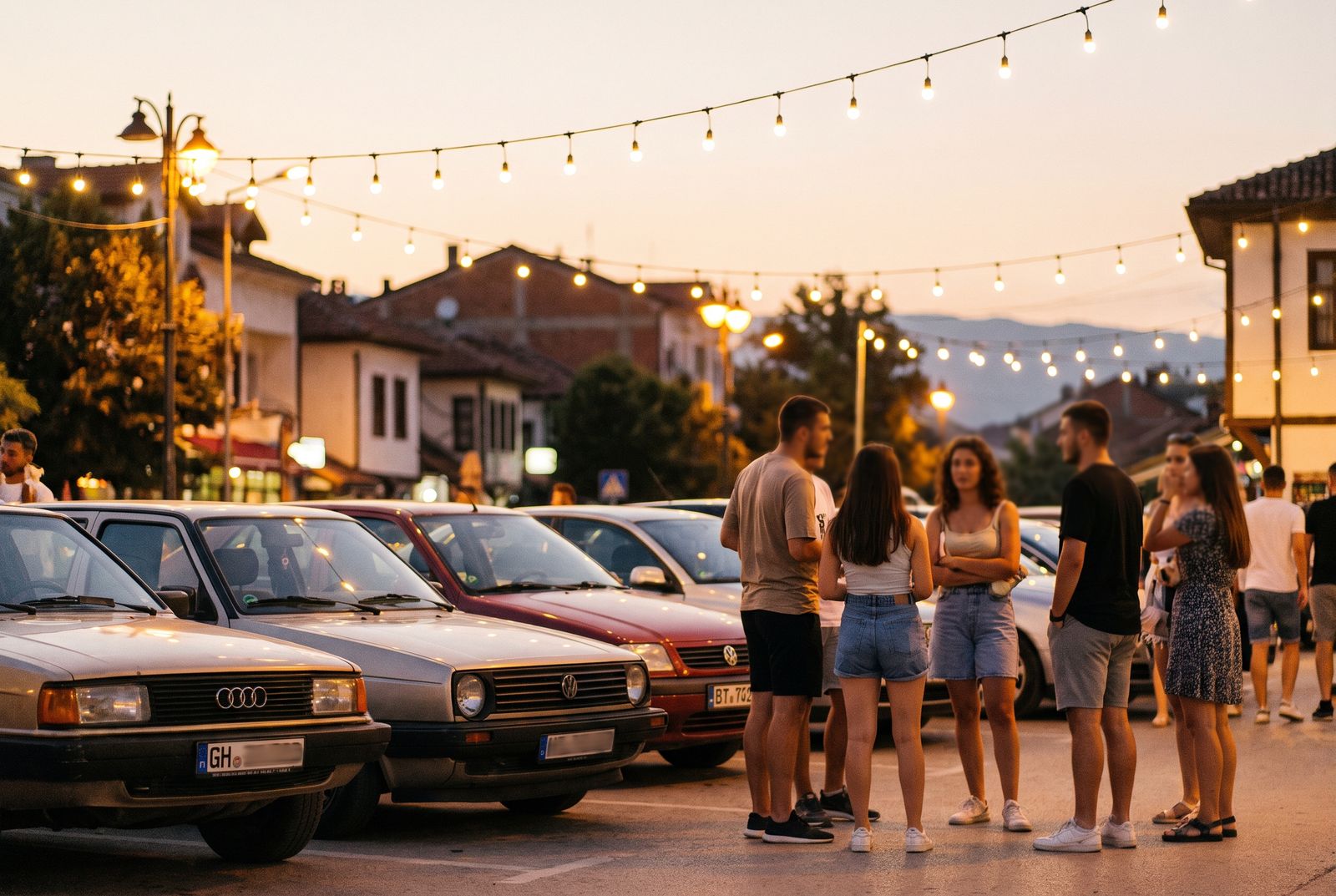
Every July, a season begins in Kosovo and Albania that appears in no calendar yet everyone knows by name: the Schatzi season. The diaspora comes home for the summer weeks, wedding halls are booked out months ahead, and anyone single knows these four weeks work differently from the rest of the year. This is the story behind the phenomenon, why the word “Schatzi” is warmer than it sounds from the outside, and how a summer acquaintance becomes something that survives September.
What the Schatzi season is
From early July, the roads between Prishtina, Prizren and Gjakova fill with cars carrying plates from Stuttgart, Zurich and Vienna. Hundreds of thousands of Albanians from the diaspora spend their annual holiday back home. For a few weeks, a community that normally lives scattered across half of Europe gathers in one place: the cousin from Basel, the school friend from Munich, half a wedding party from the Ruhr valley.
That simultaneity changes a great deal, including how people meet. For eleven months, diaspora and homeland see each other mostly on screens. In July, suddenly everyone sits in the same cafés, dances at the same weddings and strolls across the same square after sunset. Why this density of encounters produces so many couples is something we unpacked in our piece on diaspora summer romance. The Schatzi season is, in a way, that phenomenon's nickname, as seen through the eyes of those who live in the country all year round.
Because from that side, the summer has a clear pattern: young people arrive from abroad, well dressed, in a good mood, on a tight schedule, and some of them arrive with an unspoken mission. Visiting family and lying on a beach is only the official part. They also want to meet someone who comes from the same world.
Schatzi, shaci: a word with a wink
The word itself is a small piece of language history. “Schatzi” is the German term of endearment that guest worker families carried home over decades. At some point, popular speech in Kosovo turned it around and pinned it on the returnees themselves: whoever pulls up in summer with German plates and keeps showing up at weddings is a Schatzi, in Albanian shaci, plural shacat. The term has even reached Swiss media; Swiss public broadcaster SRF dedicated a report to the search for a Schatzi in Kosovo.
You can read the word as mockery, and sometimes it is meant that way. But anyone who hears only mockery misses the point. The Schatzis are not strangers descending on the country. They are the community's own children, siblings and cousins. They are people who work shifts eleven months a year, dream in German or Swiss German, and still want their children to be able to dance the valle, the traditional round dance. The joke about the Schatzi is a family joke. It is told about each other, not about outsiders, and most people telling it have an uncle in Dortmund themselves.
Honesty also requires saying this: the wish behind the Schatzi season is a rather sensible one. If you grew up abroad and want a person with whom language, humour and family rhythm simply work, you will find such people concentrated in the one place where everyone gathers in summer. That this grew into a season of its own, with its own rituals, follows almost inevitably from a life lived in two countries.
Why summer is the matchmaking season
It is no accident that summer is when things get decided. It is the only stretch of the year when families are complete, and family still plays a load-bearing role in how Albanians meet, sometimes discreetly, sometimes very directly.
It starts with the weddings. People living abroad can only celebrate during the holidays, so nearly every family schedules the dasma, the big wedding celebration, for July or August. In many towns, one celebration follows the next, and each of them doubles as a place where single people meet, observed by mothers and aunts with an astonishingly precise memory for who is still available. One evening at a wedding settles questions that would take weeks online: who belongs to which family, from which village, with what reputation.
Then there is the quiet groundwork. Many families already know in spring who is supposed to be “introduced” this summer. An aunt has someone in mind, a neighbour casually mentions that her cousin's daughter will also be around in July. This is not an arranged marriage, as outsiders sometimes assume. It is closer to a referral network that makes suggestions; the two people involved still decide for themselves. How the diaspora navigates between that network and its own ideas is the subject of our piece on dating in the Albanian diaspora.
And finally, the calendar itself: four weeks are short. That scarcity accelerates everything. A first date that might be postponed for weeks in Germany happens in Kosovo three days after the first eye contact, because both people know that August ends.
Packed halls, long convoys: the biggest party season of the year
To understand the Schatzi season, you have to picture the scale of these weeks. It is by far the biggest celebration season of the year. Wedding halls are booked far in advance, good musicians even further, and on Saturdays honking car convoys with flags roll through the towns, often several on the same afternoon. Restaurants put out extra tables, hair salons work flat out, and the café terraces take orders deep into the night.
A large part of this summer is paid for with money earned in Wolfsburg or Winterthur. The diaspora brings its savings home and spends them visibly: on its own weddings, on the celebrations of relatives, on long evenings with friends. You can turn your nose up at that, or you can see it for what it is: people who live frugally for eleven months allow themselves one month in which the life they work towards all year actually takes place. Anyone who sees only showing off in the packed hall misses the one moment in the year when both halves of a family sit at the same table.
For meeting someone, all of this means the stages are set, and there are many of them. Hardly a week without an invitation, hardly an evening without an occasion. Anyone who meets nobody during these weeks almost has to be trying.
Four weeks to build something real
The real art of the Schatzi season is not meeting people. The summer takes care of that by itself. The art is telling, within four weeks, whether a relationship is forming or just a beautiful backdrop. A few things help more than any holiday romance ever will.
Say what you expect, early
The most common mistake is silence out of politeness. Two people spend three intense weeks together and talk about everything except what this actually is. Yet the question is simple and is allowed to come early: are you looking for something serious, and can you imagine a relationship across the distance? Whoever dreads the answer usually already has it.
Involve the family, at your own pace
Back home, introductions travel fast. One shared coffee, and by the next day half the street knows. That can be a good thing, because it creates commitment. It can also build pressure that a young acquaintance does not need. It is perfectly fine to bring in the families only once both of you want to, and just as fine to do it right away if it feels right. What matters is that both move at the same speed and neither presents the other with a done deal.
Take the warning signs seriously
The season has its shadows too, and most of them announce themselves:
- Everything stays vague. No surname, no clear answers about home town, work or plans. Whoever is still fogging things up after two weeks has a reason.
- Life back home is off limits. Someone who never talks about their everyday life in Germany or Switzerland may be keeping that life deliberately separate.
- It has to get binding immediately. A proposal after ten days can be love. It can also mean someone wants to force a decision before questions get asked.
- Papers come up early. When visas, marriage and relocation are discussed faster than feelings, caution is warranted, in both directions.
- Things go quiet after the holiday. Whoever only writes sporadically in September has given their answer. It stings, but better to read it early.
None of these signs is a verdict on its own. Together they form a picture, and that picture deserves a look before the families start making plans.
After the summer: long distance, done honestly
When August ends and it is serious, the part begins that nobody talks about at the weddings: the distance. Usually it becomes a long-distance relationship between diaspora and homeland, and that follows different rules than the summer did. There is no time difference between Germany and Kosovo, but there are flight prices, holiday allowances and the one question that cannot be postponed forever: who eventually moves to whom?
Being realistic means fixed rituals for staying in touch instead of a permanent chat stream, a reunion booked before you part at the airport, and an honest time horizon. A long-distance relationship set up for an indefinite period rarely holds. One that moves towards a shared goal can hold very well, even for years. The details, from visit rhythms to the honest cost of it all, are in our guide to the long-distance relationship between Germany and Kosovo.
And do not forget the asymmetry: for the person living in Kosovo, the relationship almost always means the bigger change. Anyone coming from the diaspora should know that and say it out loud, instead of treating it as a given.
Summer is the beginning, not the requirement
The Schatzi season proves the same thing every year: the wish to find someone from your own world is enormous, and four weeks in July are a very small window for it. Some get lucky and meet the right person in the right summer. Many fly back in September wondering why the search should be confined to one month a year.
It does not have to be. embla is the dating app for Albanians worldwide, for the diaspora and the homeland alike. It makes what a Kosovo summer can do possible all year round. The app is launching soon, and the waitlist is open.
Frequently asked questions
What is a Schatzi in Kosovo?
Schatzi is the half-affectionate, half-ironic nickname used in Kosovo for diaspora Albanians who come home in summer and, among other things, look for a partner. The word comes from the German term of endearment Schatz, meaning treasure or darling, and has long been part of everyday speech.
What does shaci mean?
Shaci is the Albanian spelling of Schatzi. It refers to Albanians from the diaspora, usually from Germany, Switzerland or Austria, who spend July and August in Kosovo or Albania. The term is used with a wink, sometimes teasing, sometimes proud, but rarely with malice.
Why do so many Albanians get married in summer?
Because summer is the only time the diaspora is home in full. Families schedule weddings almost exclusively for July and August so that relatives from abroad can attend. That compresses the wedding season into a few weeks in which the halls are packed weekend after weekend.
How serious are summer romances in Kosovo?
As serious as the two people decide to make them. Many marriages in the community began in a single summer, while a share of holiday romances end with the return flight. What matters is an honest conversation about intentions before the holidays end, plus a concrete plan for what comes after.
Ready for a spark instead of a thousand swipes?
Join the free waitlist and secure 6 months of embla+ free.