Weddings
Albanian Wedding: Who Pays for What?
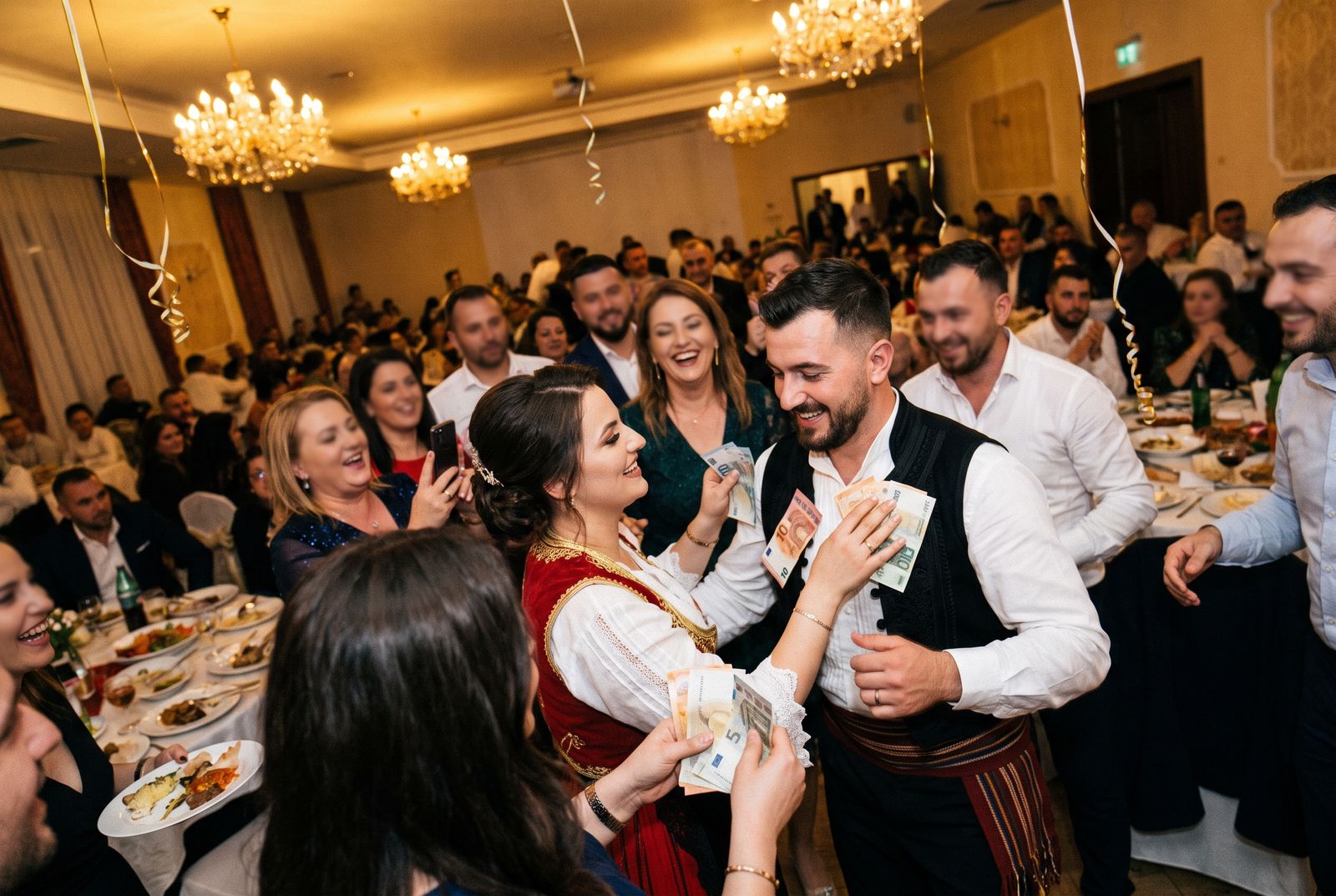
Traditionally, the groom's family pays for most of an Albanian wedding: the hall, the food, the music of the main celebration and the bride's gold. Today the answer is more nuanced, because many couples earn their own money and contribute or take over the celebration entirely, especially in the diaspora. Who carries which cost is still no accident. It follows an old logic worth knowing before the subject comes up at the family table. This guide sorts out the traditional split, the money gifts guests bring, the money dance, the gold, and the conflicts that a single early conversation can prevent.
The traditional split: groom's side and bride's side
To understand the division, it helps to know how a dasma, the Albanian wedding, is classically structured. Traditionally the two families celebrate separately. The bride's family hosts its own evening, in Kosovo often called kanagjegji, the bride's farewell from her parents' home, with its own music and its own guests. The groom's family carries the big main celebration, where the bride is welcomed into her new family. The cost split follows almost automatically from that order.
The groom's side traditionally carries the lion's share: the large hall, food for several hundred guests, the live band, photographer and video, the car convoy, and on top of that the bride's gold. In many regions the bridal dresses historically also came from the groom's family. The logic behind it: the family gaining a daughter-in-law shows the whole community that it can and will provide for her.
That does not let the bride's side off the hook. It pays for its own celebration, and it sends the bride off with her trousseau, in Albanian paja or çejzi: linens, handmade textiles, household items, once collected over years and handed over visibly on the wedding day. The engagement celebration, the fejesa, is hosted by the bride's family or shared, depending on the region. How the engagement works and what the whole celebration involves is covered in our overview of the Albanian wedding.
| Item | Traditionally paid by | Today often |
|---|---|---|
| Main celebration: hall, food, drinks | Groom's family | Groom's side, the couple, or mixed |
| Live band and music of the main event | Groom's family | Groom's side or the couple |
| The bride's gold | Groom's family | Still almost always the groom's side |
| Bridal dresses | Regionally often the groom's side | The bride or the couple |
| Bride's family celebration (farewell evening) | Bride's family | Bride's side, often smaller than before |
| Trousseau (paja, çejzi) | Bride's family | Bride's side, more symbolic than before |
| Engagement celebration (fejesa) | Regionally bride's side or shared | Shared or the couple |
| Photo, video, decoration of the main event | Groom's family | The couple |
The table is a guide, not a law. There are real differences between north and south, between Kosovo, Albania and North Macedonia, and every family has its own reading. That is exactly why it pays to ask early how things were handled in both families.
What is changing today: couples pay their share
The traditional split comes from a time when young couples had little income of their own and the extended family carried the celebration as a joint project. In the diaspora, that time is over. Someone working in Germany, Switzerland or Austria often earns more than their parents ever did, and then also wants a say in what their own celebration looks like.
In practice, mixed models have taken over. The groom's parents take the hall, the couple pays for music, photography and extras. Or the couple pays for everything and, as a gesture of respect, gives the parents a free hand with part of the guest list. The two separate family celebrations also frequently merge into one big evening in the diaspora, if only because two halls in Germany simply cost double.
One thing has barely changed: whoever pays has the bigger say. That is not an Albanian peculiarity, but here it is rarely said out loud, and it still shapes every decision, from the choice of band to whether the neighbours from the parents' home village get invited. Couples who pay for themselves are also buying decision-making freedom. That is worth knowing before accepting the parents' generous offer.
Money gifts as a guest: the logic to follow
The most common guest question: how much money is appropriate? There is no fixed amount, and any concrete number would be a lie, because the ranges vary widely by country, family and closeness to the couple. What does exist is a logic that almost always lands right.
First: the gift should roughly cover what your seat costs the hosts. An evening in a big hall with a multi-course menu costs real money per guest, and the money gift is the guests' way of returning that hospitality. To get a feel for what halls and menus run to, see the community figures in our piece on the cost of an Albanian wedding.
Second: closeness to the couple decides everything else. Distant acquaintances and colleagues stay close to that base level. Friends add noticeably more. Uncles, aunts and close family friends give considerably more, and the closest relatives often give no cash at all, but gold. Gifts are given per household, not per person: a married couple with children gives one envelope that represents the whole family.
Third: the location matters. Celebrations in the diaspora are more expensive, so envelopes there are heavier than at a wedding in Kosovo or Albania. And fourth, the simplest advice of all: ask your parents. They usually know exactly what that family gave at earlier occasions, and reciprocity is the quiet ground rule of the whole system. If you are unsure how to behave as a guest beyond the envelope, the essentials are in our guest etiquette guide for Albanian weddings.
The money dance: banknotes in the circle dance
Anyone attending an Albanian wedding for the first time will eventually be startled by flying banknotes. In the middle of the valle, the circle dance, guests pin notes onto the couple's clothing or into the bride's hair, throw them over the dancers, or wave them at the band when requesting a song. It is the moment that draws the most amazement on videos, and it is often misunderstood.
Showing off is at most half the truth here. Above all, the money dance is the public, loud form of support: the community visibly demonstrates that it stands behind the couple and wants to ease their start into married life. That a bit of theatre creeps in when an uncle throws with particular flair is part of the truth, and part of the fun.
Important for guests: the notes during the dance are a gesture, not the gift. Small notes are perfectly fine for this; it is about the movement and the joy, not the amount. The actual money gift is handed over in an envelope, usually discreetly at the greeting or at a place set up for it. Whoever only throws during the dance and forgets the envelope has confused the two.
Gold at the Albanian wedding
Gold plays a role at the Albanian wedding that goes far beyond jewellery. The central gold gift comes from the groom's family: classically a set of necklace, earrings, bangle and ring, presented at the engagement or the wedding. This gold belongs to the bride alone. It is her security, a value that stays hers whatever happens. That is why this item is rarely cut, even when the rest of the celebration is kept modest.
Gold can also be the right gift from a guest, but only from up close. Siblings, uncles and aunts, godparent families and very close friends often give gold coins, bangles or jewellery instead of an envelope, presented or pinned on visibly at the reception. A distant acquaintance giving gold, on the other hand, overshoots rather than impresses. The simple rule of thumb: gold comes from the closest family, cash from everyone else.
There is a good reason so many people search for the gold at Albanian weddings: in photos and videos it is impossible to miss, because the bride often wears everything she has been given on the big day. That is less a display of wealth than a tribute to the givers. Wearing your gold shows you have accepted the gesture.
Common conflicts and how modern couples solve them
Where money, honour and two families meet, there is friction. A few conflicts appear so reliably that you can predict them. The classic is the guest list: the parents contribute and, following the old logic, invite half the home village, while the couple would rather celebrate smaller. Behind it sits the unwritten rule that whoever helps pay gets a say.
The second evergreen is the two families' different expectations. When one side is used to a large traditional celebration and the other wants it more modern, two ideas of what is proper collide, with the couple stuck in between. The third and touchiest point: the money gifts. Who owns the envelopes at the end of the night, the couple or the parents who financed the celebration? In some families the money is seen as flowing back to whoever paid, in others as the couple's starting capital. Those who do not settle this beforehand settle it afterwards in a fight.
Modern couples solve this almost always the same way, and early. One open conversation with both families before anything is booked saves months of tension. Three simple agreements help:
- Split the budget by blocks, not percentages, and put it in writing: whoever pays for the hall pays for the hall, done. That is clearer than any quota.
- Fix the rule for the money gifts in advance and communicate it identically to both families, whether they go to the couple or partly back to those who paid.
- If you want full freedom of decision, pay yourself. You can even say it to the parents with love: your gift is that you come and celebrate as guests.
None of this is un-Albanian. On the contrary, the early, respectful conversation between families is the most traditional form of conflict resolution this culture knows.
What people do not talk about openly
Finally, the taboos, because they are written on no invitation. The exact amounts of money gifts are not discussed publicly, neither by the giver nor the receiver. At the same time, many families quietly keep track of who gave how much at which wedding, in order to reciprocate properly at the return visit. The two go together; it is the same courtesy from two sides: you remember precisely, and you do not talk about it.
Likewise, you do not ask the couple or the families what the wedding cost, and you do not loudly compare one bride's gold with another's. Debts taken on for a celebration are also passed over in silence, although they exist. As a guest, one rule always keeps you safe: admiring is welcome, putting numbers on things is taboo.
So who pays for the Albanian wedding? Traditionally the groom's family, increasingly the couple themselves, and in a deeper sense the whole community, which gives back in envelopes, gold and flying banknotes what it once received itself. Before that question ever comes up, though, there is a nicer one: who you want to celebrate all of it with. embla is the dating app for Albanians worldwide, for everyone looking for a person with the same roots. The app is launching soon, and the waitlist is open.
Frequently asked questions
Who pays for an Albanian wedding?
Traditionally the groom's family carries most of it: the big celebration with the hall, food and music, plus the bride's gold. The bride's family hosts its own smaller celebration and sends the bride off with her trousseau. Today many couples pay part or all of it themselves, especially in the diaspora.
How much money do you give at an Albanian wedding?
There is no fixed amount. As a guide, the gift should roughly cover what your seat costs the hosts, and it grows with how close you are to the couple. Close relatives give considerably more than distant acquaintances, often gold instead of cash. When in doubt, ask your parents what is customary with that family.
What does the gold at an Albanian wedding mean?
Gold is the gift of the closest family to the bride, traditionally a set of necklace, earrings, bangle and ring from the groom's family. It is seen as the bride's security and belongs to her alone. Close relatives also often give gold coins or jewellery instead of an envelope.
What is the money dance at Albanian weddings?
During the dance, guests pin or throw banknotes onto the couple, often in the middle of the circle dance. The gesture publicly shows joy and support for the couple's new life. The real monetary gift is still given in an envelope; the notes during the dance are mostly symbolic.
Do Albanian couples pay for their own wedding today?
Increasingly yes, in full or in part. In the diaspora many couples earn well and want a say in their own celebration instead of leaving the bill to their parents. Mixed models are common: the parents take the hall, the couple takes the rest. Traditionally, whoever pays also has the bigger say over the guest list.
Ready for a spark instead of a thousand swipes?
Join the free waitlist and secure 6 months of embla+ free.