Weddings
Albanian Wedding Traditions Explained
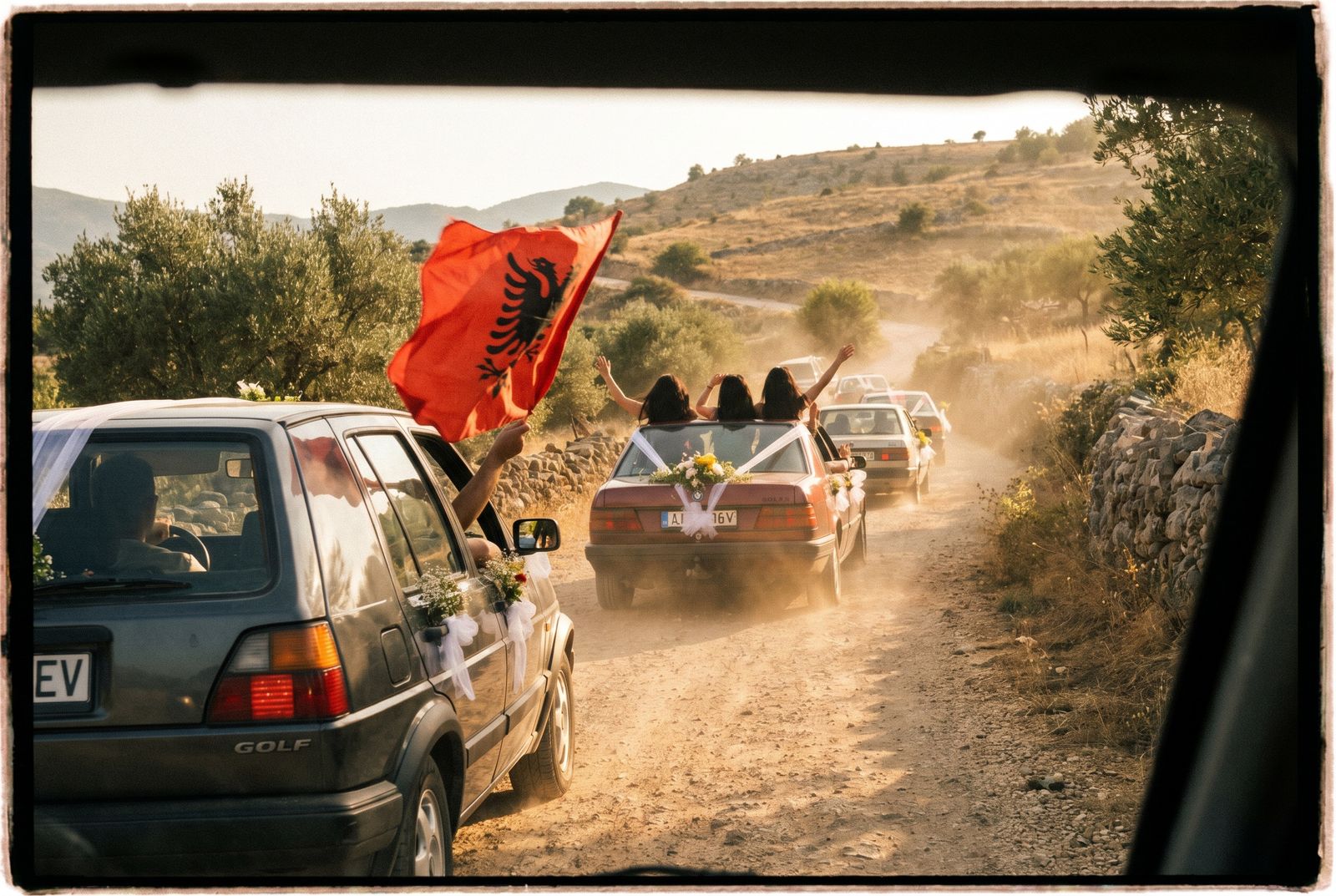
Albanian wedding traditions all circle one idea: two families becoming one. From the convoy that collects the bride, to the bread and honey waiting on the doorstep, to the red flag with the double-headed eagle, the rituals of a dasma carry meaning far older than the modern halls and live bands. Much of it lives on in the diaspora, adapted to a flat in Stuttgart or a hall in Zurich, but rarely forgotten.
This article walks through the most beautiful and important customs, where they come from and what they mean. If you want the full running order of the day, you will find it in the overview of the Albanian wedding.
Collecting the bride: marrja e nuses
The most visible custom is the collection of the bride. A group of guests from the groom's side, the krushqit, drives to the bride's family home to bring her out with ceremony. In practice this is a convoy of decorated cars, often trailing white ribbons and flowers, engines honking, moving loud and proud through the streets. In the Balkans a procession like this pulls whole villages to their windows. In a German city it earns a few surprised looks at the traffic lights.
At the family home the convoy is welcomed and fed before the bride is handed over. This moment is deliberately slow. The bride's family does not simply let her go. She is seen off, blessed, often sung to. Only then does the procession set out toward the new home or the reception hall.
Leaving the family home
The farewell is one of the most emotional points of the whole day. Traditionally the bride shows sorrow as she leaves her parents' home, and in many regions this counts not as a bad omen but as a sign of a deep bond with her own family. The phrase "nusja qan", the bride weeps, describes not a disaster but an expected, honourable expression of feeling.
In some places old farewell songs accompany this walk. The mother sends her daughter off with advice and a blessing, the father hands her over in a symbolic gesture. Today this part runs shorter or longer depending on the family, but the underlying feeling stays the same: something ends so that something new can begin.
The flag rides along: flamuri
At few other occasions is the red flag with the black double-headed eagle as present as at a wedding. It is tied to the lead car, held out of a window, or waved during the procession. To outsiders it can look like a political symbol, yet the meaning is almost always different. It is a statement of shared heritage, a visible "we belong together" that ties a private family celebration to a larger sense of belonging.
In the diaspora the flag carries extra weight. Living far from Kosovo, Albania or North Macedonia, families use it to show, on one of the most important days of their lives, exactly where they come from.
Bread, honey and the threshold
When the bride arrives at her new home she is often welcomed by her mother-in-law, the vjehrra, with bread and honey, and in some families with salt as well. The symbolism is clear and lovely. Honey stands for a sweet, kind life under the new roof, bread for prosperity and blessing, salt for endurance. In some areas the bride dips a finger in the honey and marks the doorframe so that good fortune stays in the house.
Smaller gestures come with it, and they shift from region to region. Sometimes the bride throws sweets or rice, sometimes a small child is placed in her arms, an old wish for children and a lively home. These customs are kept today with a straight face or a wink, depending on how traditional a family is.
Marriage traditions in Kosovo: the role of the son and the family
In Kosovo, marriage has traditionally never been the couple's affair alone but that of the groom's whole family. The son is not expected to court on his own but with his parents and older relatives behind him. The father or an uncle accompanies the formal proposal to the bride's family, and the consent of both households counts as much as the couple's own. To marry as a son is to take on a role within the fabric of one's own family.
Particular expectations rest on the eldest and the youngest son. In many rural regions the youngest son traditionally stayed in the parental home and cared for the parents in old age, while his wife moved into the in-laws' household. Several generations under one roof was long the norm, and the daughter-in-law, the nusja, found her place in that larger house.
Much of this is now changing. Many couples set up their own home, the roles are negotiated more freely, and it varies strongly by region. In the diaspora the expectation of living together loosens further, because flats are smaller and distances longer. What stays is the underlying idea: two families marry, and the son carries responsibility for both sides.
The henna night: nata e kanës
On the evening before the wedding many families hold the henna night, the nata e kanës. It is a gathering in a close, mostly female circle where henna is applied to the bride's hands. There is singing, often by candlelight, and tears flow as readily as laughter. The custom is especially alive in Muslim-heritage families and in North Macedonia, though variations turn up elsewhere too.
The henna on the hands is more than decoration. It marks the passage from daughter to wife, a last evening among familiar faces before the big day. In the diaspora this night happily moves into the living room: a few friends, a little henna, the same songs playing from a phone.
Gold and pinned banknotes
Money and gold are on open display here, with no embarrassment attached. The groom's family often gives the bride gold jewellery, some of it handed over and worn in public. During the dancing, guests pin banknotes to the couple's clothes or press them into their hands. What can look like showing off from the outside follows a clear logic of reciprocity: whoever gives today was given to yesterday and will be invited again tomorrow. The money gives the young couple a concrete start, the gold stays on as value and as memory.
Music, dance and the valle
No custom carries the celebration quite like the music. The live band leads the couple into the hall with a valle, the round or circle dance, hand takes hand, and the line grows until half the wedding is dancing. Music at a dasma is not a garnish but the emotional engine of the night. How the dances work and why the live music matters so much is covered in detail in our piece on Albanian wedding music.
Regional variety, no ranking
There is no single Albanian wedding. Between Kosovo, Albania and North Macedonia, and even between neighbouring villages, the customs differ in their details. No version is more "correct" than another. They simply tell different stories of the same occasion.
| Region | Especially alive | In brief |
|---|---|---|
| Kosovo | Large car convoy, flag, often a two-day celebration | The procession of the krushqit is central and staged on a grand scale |
| Southern Albania (Tosk lands) | Multi-part singing (iso-polyphony) | Old songs without instruments shape the festive sound |
| Northern Albania (highlands) | Traditional dress, old codes of honour | Solemnity and costume play a large part |
| North Macedonia (Tetovo, Gostivar, Struga) | Strong henna night, rich jewellery | The nata e kanës and the bridal outfit take centre stage |
This table is a guide, not a box. Every family blends, drops and adds whatever matters to it. If you are especially drawn to the dresses and the jewellery, there is more in our article on the Albanian bridal dress.
What the diaspora keeps
In Germany, Switzerland and Austria a wedding looks different from the one back in the home village, and yet surprisingly similar. The convoy winds through the city centre instead of down a country road. The hall is booked months ahead, the band sometimes flown in. The henna night happens in the living room, the bread-and-honey welcome at a third-floor front door.
What tends to change is the length. Several days become one long weekend or a single very full evening, because work calls again on Monday. What stays is the core: the families, the flag, the gestures of welcome, the music. Many in the second and third generation rediscover these customs as adults, looking on purpose for what their grandparents lived without a second thought.
That feeling, of finding someone who knows the same songs and does not need the word nusja explained, is exactly why embla exists. embla is the dating app for Albanians around the world, for everyone who wants to share a language, the same celebrations and the same small rituals. The app launches soon, and the waitlist is open.
Frequently asked questions
What are typical Albanian wedding traditions?
The best known include the bride collection by a convoy of cars (marrja e nuses), carrying the red flag with the double-headed eagle, welcoming the bride with bread and honey at her new home, the henna night (nata e kanës), and pinning banknotes to the couple along with gifts of gold during the dancing.
Why does the bride cry at an Albanian wedding?
Leaving her parents' home is an emotional high point of the day. The bride's tears are traditionally not seen as a bad sign but as a sign of her bond with her own family. In many regions, farewell songs accompany this moment.
What do bread and honey mean at an Albanian wedding?
As the bride enters her new home she is often welcomed with bread and honey, sometimes with salt too. Honey stands for a sweet, good life, bread for prosperity and blessing in the house, and salt for endurance. In some families the bride marks the doorframe with honey.
What is the henna night (nata e kanës)?
The henna night is a celebration in a close, mostly female circle on the evening before the wedding. Henna is applied to the bride's hands while the women sing. The custom is especially alive in Muslim-heritage families and in North Macedonia.
What role does the flag play at an Albanian wedding?
The red flag with the black double-headed eagle is often tied to the lead car of the convoy or waved during the procession. It links a private family celebration with a visible statement of shared heritage.
Ready for a spark instead of a thousand swipes?
Join the free waitlist and secure 6 months of embla+ free.
Save my spot