Weddings
Albanian Bridal Dress: Tradition and the White Gown
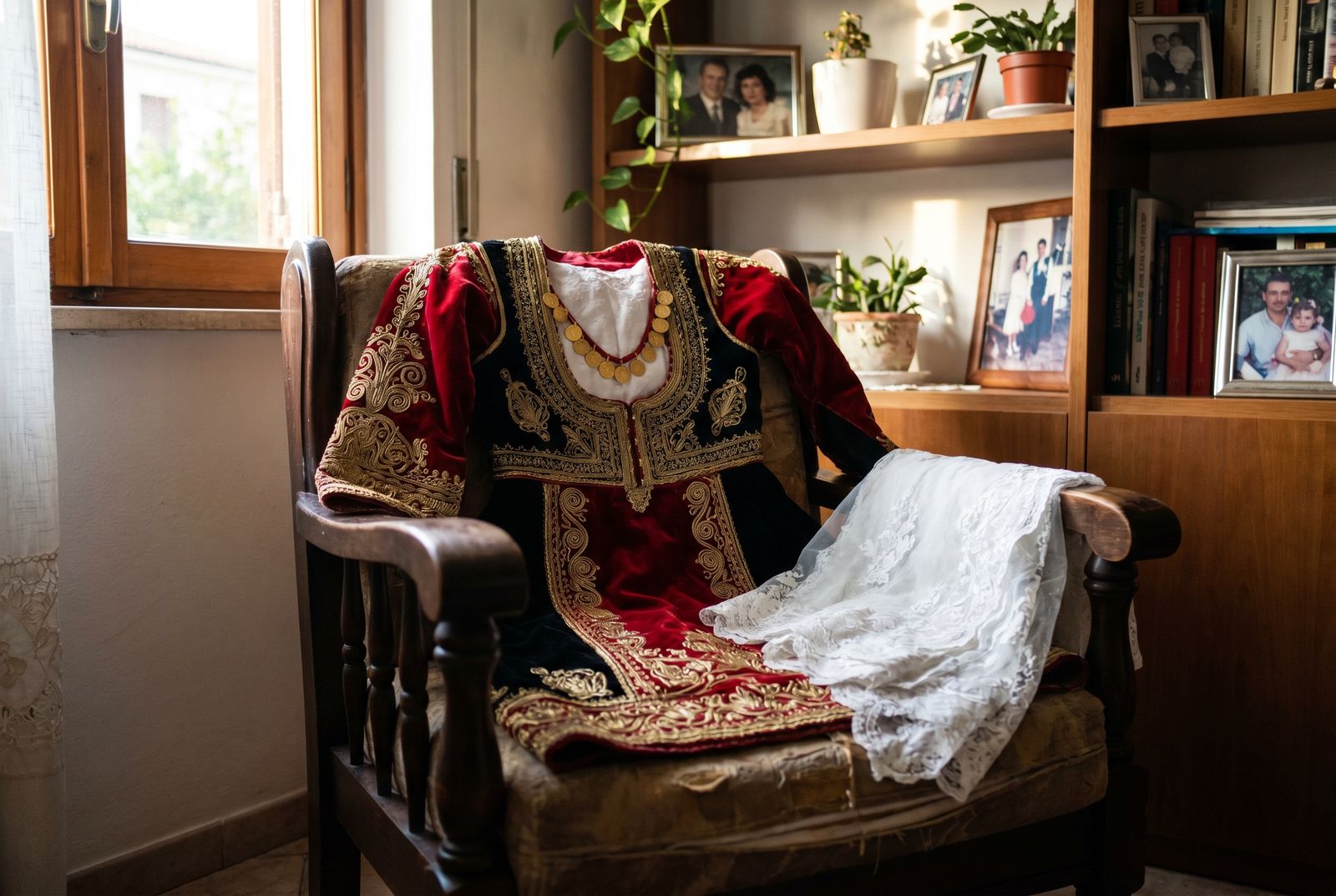
An Albanian bride today rarely wears just one dress. For the ceremony and reception it is usually a white, western-cut gown; for part of the celebration she puts on the traditional costume of her region, and often a coloured evening dress for dancing. The traditional bridal costume, in Albanian veshja e nuses, is not a prop for a photo. It is a piece of family history made of embroidery, gold and silver. Understand what sits inside these fabrics and you understand a lot about the dasma, the Albanian wedding.
What the traditional costume is made of
The old bridal costume is weeks, sometimes months, of handwork. At its core is a richly embroidered bodice of velvet or fine wool, worn with a long robe or full skirt, a patterned apron, and a headpiece hung with coins, ribbons and a veil. The embroidery is never random. Vines, suns, birds and geometric marks all carry meaning and repeat across generations within one family or one village.
The first thing you notice when you hold such a costume is the weight. The gold thread, the sewn-on coins and the silver chains make the garment heavy. A bride moved in it slowly and upright, and that was part of the effect. The costume was meant to be seen. Without a word, it told the guests where the bride came from and what rank her family held.
Many regions, not one costume
There is no single Albanian bridal dress. Between Kosovo, northern and southern Albania and the Albanian regions of North Macedonia, the cut, the colours and the jewellery differ sharply. That variety is the real wealth, and it is worth knowing, especially in the diaspora, where a grandparent's exact origin often blurs.
- The northern Albanian highlands: home of the xhubleta, a bell-shaped, pleated skirt of felted wool, usually black with coloured trim. It counts among the oldest garments in Europe, and making it is so demanding that UNESCO added the xhubleta in 2022 to the List of Intangible Cultural Heritage in Need of Urgent Safeguarding.
- Kosovo and the Has and Opoja regions: known for especially opulent, colour-rich bridal costumes with dense gold and silver embroidery. Around Has there was an old tradition of decorating the bride's face with fine symbolic marks, dots and lines meant to signal protection and fertility.
- Southern Albania, Toskëria and Labëria: calmer, often more elegant lines, fine white embroidered shirts worn with waistcoats and belts closed by silver buckles. The jewellery is more delicate, the effect less heavy but no less refined.
- The Albanian areas of North Macedonia: their own patterns and colour combinations, frequently strong red and dense coin work that give the region's ties to its neighbours a distinct note.
Trace your own family's costume back and you often land in a single village with one very specific pattern. That is exactly where the value lies. The costume is local, not flattened into one national look.
Gold and silver as a language of their own
Albanian bridal jewellery reads like a ledger of a family's standing. Across generations, households gathered gold coins, chains, brooches and forehead ornaments, and much of it passed to the bride at her wedding. This was not mere display. The gold belonged to her. It was her security, her own property, carried into the new family and kept.
One town stands out for this craft: Prizren in Kosovo, famous for its silver filigree, the filigran. Thin silver wires are bent into fine tendrils and blossoms and soldered together, producing brooches and chains of great delicacy. Families still pass such pieces down, and many brides in the diaspora wear their grandmother's jewellery on the day even when they otherwise choose a modern white gown.
The forehead ornament deserves a look of its own. Rows of small gold coins, often laid across the brow, caught the light with every movement and drew the eye to the bride's face. In some families these coins were gathered over decades, each with its own small story of who gave it and when. So the bride wore not only gold, but the memory of several generations visibly upon her.
The meaning of colour and the veil
Red runs through nearly every region. It stands for life, fertility and protection, and the red veil or red panel was meant to shield the bride from the evil eye. White, as we know it from the wedding gown today, appeared in the old costume more as the colour of purity in a detail, the embroidered shirt for instance, rather than of the whole garment.
The veil held a practical and a symbolic role at once. It covered the bride on her way from her parents' house to her new home and was lifted at a certain moment, often only at the groom or within his family. That passage, leaving one house and arriving in another, is still one of the most moving parts of an Albanian wedding, and many of the customs around the bride and the veil survive in altered form.
How a bride is dressed
Putting on the costume was never a job for the bride alone. The women of the family, her mother, aunts and sisters, dressed her, often singing and offering wishes for luck and a good life in the new home. It took time, because every buckle, every chain and the headpiece had to sit just right. Ask an older relative today and you usually get a precise memory of who dressed whom, because this was among the most intimate moments of the whole celebration.
The individual pieces had their own names and their own jobs. The belt, often closed with a heavy silver buckle, did more than hold the garment; it marked the waist as a sign of the young woman. The apron protected the costly fabric beneath and carried the finest patterns outward. Embroidered stockings, delicate gloves and the coin-hung headpiece completed the picture. None of it was arbitrary, and much of it was handed down exactly as the grandmother had worn it.
From costume to the white gown
As almost everywhere in Europe, the white wedding gown took hold in the twentieth century, pushed along by cinema, television and later social media. For many families the white gown became the mark of a modern, outward-looking wedding. The old costume slipped into the background, though it rarely vanished entirely.
What happened next is the interesting part. Instead of disappearing, the costume came back as a deliberate choice. Young couples, especially in the diaspora, want their origins to be visible without giving up the white gown. The result is a coexistence, not an either-or. The white gown and the costume now often belong to the same day.
The trend toward two or three outfits
A modern Albanian wedding day is long and has several chapters, and each now often gets its own look. The changing is not just fashion; it is practical, because dancing for eight hours in a heavy costume is barely possible. And it tells a small story: from roots, through the western ceremony, to the long night on the dance floor.
| Moment in the day | Typical look | What it expresses |
|---|---|---|
| The send-off and family part | Traditional costume or the grandmother's jewellery | roots, respect for the family |
| Ceremony and reception | White gown, western cut | the modern wedding, a shared start |
| Party and dancing | Coloured evening dress, lighter cut | joy, freedom of movement, a long night |
Not every bride makes all three changes, and no rule demands it. Some wear white all day with only the old gold jewellery. Others deliberately put the full costume at the centre. Because a day like this carries many line items anyway, it pays to look early at the cost of an Albanian wedding, where the dresses and the gold often weigh more than you first expect.
Handwork that nearly disappeared and is coming back
The greatest worry around the bridal costume is not fashion but skill. The women who could felt and pleat a xhubleta or embroider a whole costume by hand are fewer each year. That is precisely why UNESCO stepped in. What is at stake is the knowledge, not only the finished piece.
At the same time there is a counter-movement. Seamstresses and small workshops in Kosovo and Albania are making costumes for weddings again, often blending an old pattern with new comfort. In the diaspora, families rent costumes, have old pieces restored, or pair a modern gown with genuine heirloom jewellery. The costume does not turn into a museum object. It stays alive, worn by people who fill it with their own story.
For many in the second or third generation, this becomes a small piece of research. You call your grandmother in Prizren or Shkodra, ask about the village pattern, hunt through the attic for a chain that has sat wrapped in a cloth for decades. Sometimes a piece is missing, and a seamstress recreates it from an old photograph. This gathering is not a detour; it is the point. What you end up with is a costume that was assembled rather than bought, and on her day the bride wears something that speaks of real people and real places.
If you want to see how all of this fits into the flow of the celebration, the wider frame is in the overview of the Albanian wedding.
In the end the bridal costume is less a garment than a statement: of family, of region, of an origin you refuse to set aside even far from home. That feeling, being understood without a long explanation, is the reason embla exists. embla is the dating app for Albanians around the world. The app launches soon, and the waitlist is open.
Frequently asked questions
What does an Albanian bride wear at the wedding?
Most brides today wear a white gown for the ceremony and reception, plus a traditional regional costume for part of the celebration and sometimes a coloured evening dress. Many change outfits two or three times over the course of the day.
What does the colour red mean in Albanian bridal dress?
Red stands for life, fertility and protection. In many regions a red veil or red panel was part of the costume and was meant to guard the bride against the evil eye, while gold and silver signalled the family's standing.
What is a xhubleta?
The xhubleta is a bell-shaped, pleated woollen skirt from the northern Albanian highlands and one of the oldest garments in Europe. It is made entirely by hand, and in 2022 UNESCO added it to the List of Intangible Cultural Heritage in Need of Urgent Safeguarding.
Why do Albanian brides change dresses several times?
The changes signal both transformation and prosperity and link the modern day to family roots. A white gown speaks to the western wedding, the costume honours the bride's region, and a lighter coloured dress makes dancing through a long night easier.
How much does a traditional Albanian bridal costume cost?
It depends heavily on whether it is a family heirloom, a rental, or a newly made piece with real gold. A freshly sewn costume with dense hand embroidery and gold jewellery easily reaches the price range of a good wedding gown and beyond.
Ready for a spark instead of a thousand swipes?
Join the free waitlist and secure 6 months of embla+ free.
Save my spot