Weddings
Albanian Engagement: The Fejesa Explained
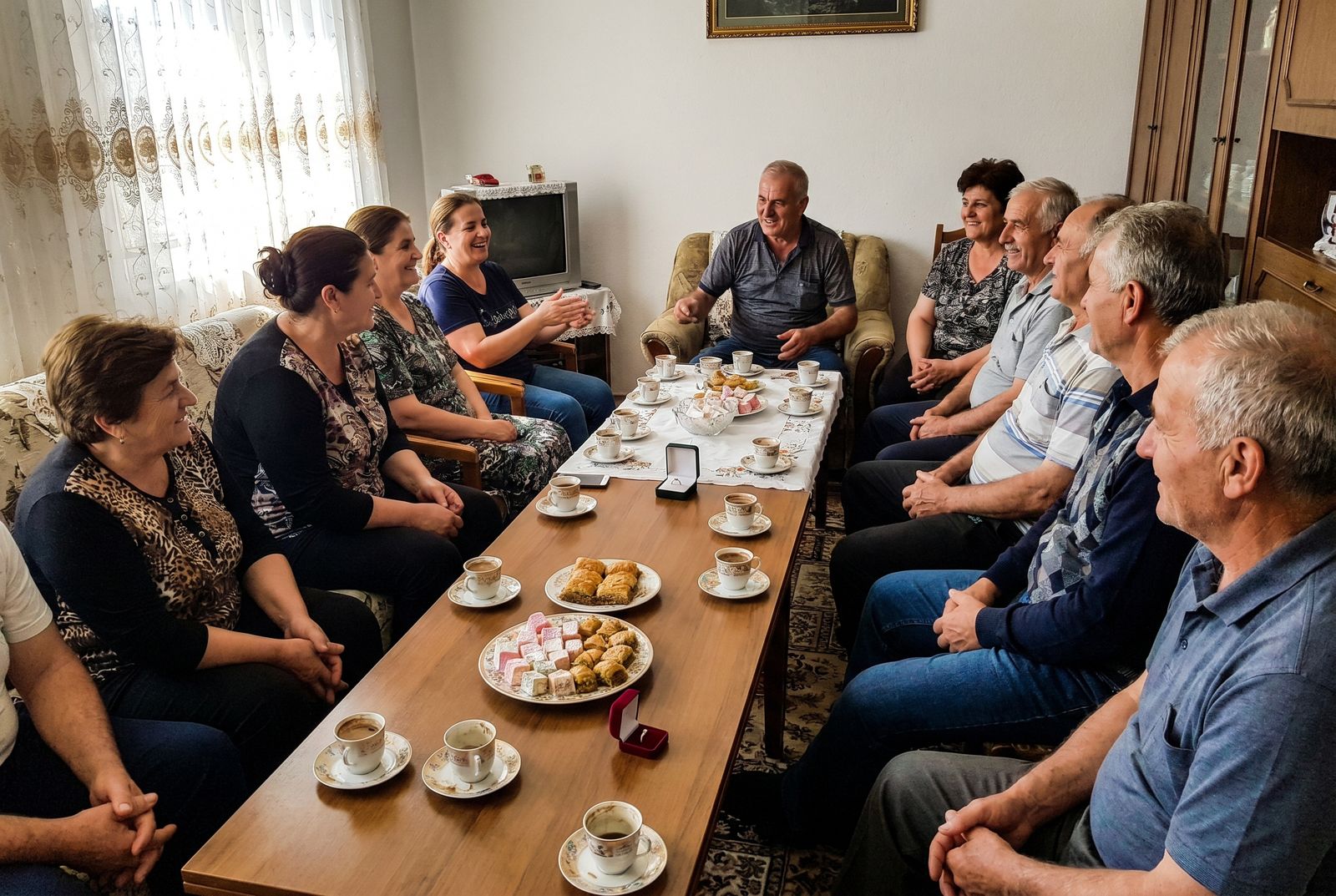
The Fejesa is the Albanian engagement: the official promise of two people to marry, confirmed in front of both families. The man and the woman exchange rings, the families get to know each other, and two people in a relationship become a bond between two households. It is more than a "yes." It is the moment a relationship turns public and binding. How big the celebration gets, and how much tradition comes into play, is something every couple decides for itself today.
What the Fejesa really means
Fejesa comes from the verb fejohem, to get engaged. It refers not just to the event but to the state that follows: you are i fejuar or e fejuar, engaged, and for Albanians that traditionally carries more weight than in many Western families. An engagement was long treated as almost as binding as marriage itself. Breaking it off was a serious step that touched both families, not only the two people involved.
Behind this sits an idea that still echoes today: an Albanian marriage joins not two individuals but two families. Parents, siblings, often uncles and aunts are part of the story. To some people who grew up in the diaspora, that can sound like a lot at first. For others, that is exactly the warmth of it. You do not marry alone; you are taken in.
Today the Fejesa has grown freer. It is still meant to be binding, but the decision rests with the couple. The ring is a promise, not a contract between fathers. Even so, the moment keeps its weight, and that is precisely what makes it beautiful.
Shkuesia: how marriages used to be arranged
To understand the Fejesa, it helps to look at the shkuesia, the traditional matchmaking. A shkues, a go-between, often a respected relative or acquaintance of both sides, brought two families together. He praised one family to the other, checked whether it was a fit, and cleared the path to the engagement. The couple themselves had little say back then, and sometimes the two met only late in the process.
It is worth resisting the urge to judge this through a modern lens. In villages with little mobility, the shkuesia was a social tool that gave families security and connected people who were complete strangers. A family's reputation, its nder (honor) and reliability, mattered a great deal.
Today the shkuesia has all but disappeared, at least in its old form. Most couples meet on their own: at university, through friends, at work, at a summer wedding, and increasingly online. Yet traces of the idea live on. When an aunt says "I know a nice family," that is a modern, soft shkuesia. The difference is that it is a suggestion, not an arrangement. Whether it fits is up to the two of them.
How an Albanian engagement works today
There is no single Fejesa. Kosovo, Albania and North Macedonia each have their own nuances, town and village celebrate differently, and every family has its habits. Even so, much of it follows a recognizable thread.
Usually the man's family visits the woman's family. You do not arrive empty-handed: flowers, sweets, often a gift. Coffee is served, people talk, feel each other out, laugh. Then comes the heart of it: the rings. The man places the ring on the woman's finger, and often she does the same for him. In many families gold jewelry is part of it, handed to the bride by the groom's family, a visible sign of regard and seriousness.
After that, there is food. And depending on the family, the celebration begins here: music, valle (the circle dance), relatives dancing until their feet hurt. One Fejesa is a quiet afternoon with twenty people in the living room. Another is a small wedding with a hall, a live band and two hundred guests. Both are right.
A small circle or a big party
Perhaps the most important choice today is the size. Broadly, two paths can be described:
| Small circle | Big party | |
|---|---|---|
| Place | At home, the living room | A rented hall or restaurant |
| Guests | 15 to 40, closest family | 100 to 300, the wider circle |
| Flow | Coffee, rings, food, music | Stage, live band, menu, dancing late |
| Length | An afternoon or evening | A whole evening, often into the night |
| Cost | Manageable | Close to a small wedding |
Many couples deliberately keep the Fejesa small and save the big party for the dasma, the wedding. Others celebrate the engagement in style, because in summer half the diaspora comes home anyway and they seize the moment. If you want to understand the full flow of an Albanian wedding, the big overview is in the piece on the Albanian wedding.
The role of the families
The Fejesa is the moment when the families meet officially. They may have crossed paths briefly before, but here it becomes formal. Both sides want to make a good impression, and both are watching: how do they speak to each other, how do they treat the parents, is respect there?
For a partner attending for the first time, this can be nerve-racking. Anyone who did not grow up Albanian feels the codes especially clearly here: stand up when elders enter the room, greet the parents first, do not point your feet at anyone, praise the food. None of it is a test with a failure rate, but attentiveness is noticed and appreciated. How to handle this first meeting with the parents well is covered in detail in the piece on meeting the Albanian family.
It is just as important to note what the Fejesa no longer is: something decided over the couple's heads. The parents give their blessing; they do not dictate. The tone between the generations has shifted, and most families know it.
The Fejesa in the diaspora
For Albanian families in Germany, Switzerland or Austria, the engagement follows its own logic, and much of it revolves around summer. Between late June and August the diaspora goes home, and that is exactly when many engagements and weddings happen, because that is when everyone is there: grandparents in Prishtina, cousins in Zurich, uncles in Stuttgart, all in the same place for a few weeks.
This raises practical questions. Do you hold the Fejesa in the homeland, where the older relatives live, or in Germany, where the couple lives? Some do both: a small gathering here, the bigger celebration there. If one partner is not Albanian, the trip comes with it, meeting the extended family, the language, the village, all for the first time. That is a lot at once, but it is also the point where "my boyfriend" becomes someone the family knows.
The diaspora also produces its own hybrids. A couple raised in Germany may want the rings and the parents' blessing but without the full old ceremony. Another holds on to every detail precisely because it lives far from home. Both are tradition in practice, just in different doses. How this generation brings tradition and its own life together is explored in the piece on tradition and modernity in Albanian relationships.
From the Fejesa to the wedding
After the engagement you are i fejuar or e fejuar. For how long is open. Some couples marry a few months later, others stay engaged for one or two years. In the diaspora the time often stretches, because summer dates, vacation days, hall bookings and sometimes paperwork for a marriage abroad all have to line up.
The engagement period is not a waiting room. It is the phase in which the two families grow closer, in which plans take shape, in which you settle in as a couple within the new, larger circle. Many describe it in hindsight as one of the loveliest stretches: the belonging is already there, the stress of the wedding is not.
In short
- The Fejesa is the Albanian engagement, meant to be binding, freely chosen today.
- The shkuesia was the traditional matchmaking through a shkues; it has nearly vanished, with a soft trace living on in well-meant family suggestions.
- The flow today: the family visit, coffee, rings, often gold jewelry, food, music.
- The size is a free choice: a quiet afternoon or a party with a hall and a band.
- In the diaspora, much of it turns on summer and on two countries.
At the start of every Fejesa there is no ring and no family, but two people who found each other. That is where everything begins today: with meeting. embla is the dating app for Albanians around the world, in the diaspora and in the homeland, for everyone looking for someone with the same roots and the same understanding. The app launches soon, and the waitlist is open.
Frequently asked questions
What is the Fejesa in Albanian culture?
The Fejesa is the Albanian engagement: two people's official promise to marry, confirmed in front of both families. The couple usually exchanges rings, the families get to know each other, and the wedding moves into view. It is meant more seriously than a Western engagement, yet today it is freely chosen by the couple.
What is the difference between Fejesa and shkuesia?
The shkuesia was the traditional matchmaking: a go-between or relative brought two families together and arranged the marriage. The Fejesa is the engagement itself. In the past the Fejesa often followed a shkuesia; today most couples meet on their own and the shkuesia has nearly disappeared.
How does an Albanian engagement work today?
The man's family usually visits the woman's family, coffee is served, people talk, then come the rings and often gold jewelry, followed by food and music. Some celebrate quietly at home, others rent a hall for a hundred guests. Today the couple has a real say in how big it gets.
How long is it from the Fejesa to the wedding?
It varies a lot. Some couples marry a few months later, others stay engaged for one or two years, especially in the diaspora where summer dates and paperwork have to line up. There is no fixed rule.
Who pays for an Albanian engagement?
Traditionally the groom's family carries a large share, above all the rings and gold jewelry for the bride. Today many families split the cost or the couple contributes, particularly in the diaspora. There is no strict rule; what matters more is a good relationship between the two families.
Ready for a spark instead of a thousand swipes?
Join the free waitlist and secure 6 months of embla+ free.
Save my spot