Culture
Learn Albanian for Your Partner: 30 Words to Start
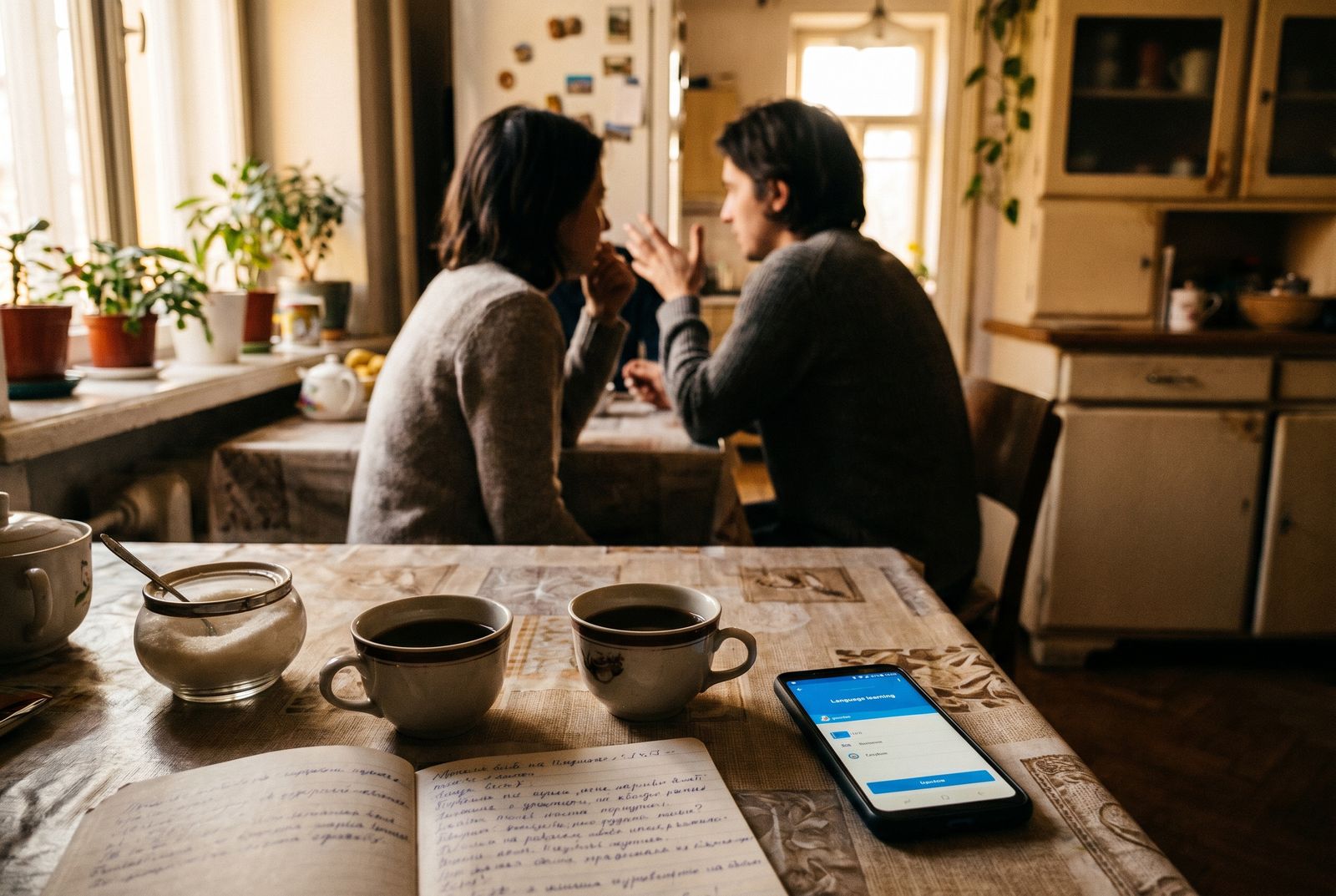
You are with an Albanian and you want a few words in their language? Start with the greeting, the thank you and a single sentence of love. That is genuinely all you need to open hearts at your first family visit. Albanian grammar is demanding, but it does not matter at the beginning. What matters is that you try.
That is what this piece is about. Not flawless sentences, but the thirty words and phrases that land instantly in an Albanian family. With their meaning, with a pronunciation guide that works without a course, and with the context of when to say what.
Why trying beats being perfect
In Albanian families, language is read as a sign of respect. Anyone who takes the trouble to learn a handful of words is saying something bigger: I mean this, I care about where you come from, I am making an effort. That lands, often more than a flawless sentence ever could.
You will make mistakes. You will swallow the ë or mangle a gj, and someone at the table will probably laugh. That laughter is almost always warm. A foreign son-in-law who manages a clumsy faleminderit over dinner wins more affection in that moment than any compliment in English could buy. Perfection comes later, if at all. The first step is the one that counts.
A quick word on pronunciation
Albanian is written almost exactly as it is spoken, once you know a few letters. These are the ones worth memorizing:
- ë is a very soft, almost swallowed sound, like the a in "sofa".
- gj is a soft "dy", close to the sound in "would you" said quickly.
- xh is the English j, as in "jam".
- q is a soft "ty", a little like the ch in "cheese" but lighter.
- ç is "ch" as in "church".
- c is "ts" as in "cats".
- y is the German ü, made by rounding your lips to say "ee".
- th as in "think", dh as in "this".
Learn those eight and the tables below almost read themselves.
The first words: greetings and politeness
This is the foundation. You need this handful at every meeting, and they are the first words an Albanian family wants to hear from you.
| Albanian | Meaning | Pronunciation (rough) |
|---|---|---|
| Përshëndetje | Hello (neutral) | per-shen-DET-yeh |
| Tungjatjeta | Hello, warm ("long life") | toon-dyat-YE-ta |
| Mirëmëngjes | Good morning | meer-muhn-DYES |
| Mirëdita | Good day | meer-DEE-ta |
| Mirëmbrëma | Good evening | meer-BRUH-ma |
| Natën e mirë | Good night | NA-tuhn eh MEE-ruh |
| Faleminderit | Thank you | fa-le-min-DE-rit |
| Të lutem | Please | tuh LOO-tem |
| Po / Jo | Yes / No | po / yo |
| Më fal | Excuse me / sorry | muh FAL |
Tungjatjeta is the traditional, especially warm greeting, and it literally means something like "a long life to you". You can never go wrong using it with your partner's parents.
The first family visit: sentences that count
The moment you are introduced to the family is a big one. How it usually unfolds, and what else matters, is laid out in our piece on meeting the Albanian family. On the language side, a few well-placed sentences in the polite form are plenty. In Albanian that is the ju form, the equivalent of a formal "you".
| Albanian | Meaning | Pronunciation (rough) |
|---|---|---|
| Gëzohem që ju njoh | Pleased to meet you | guh-ZO-hem kyuh yoo NYOH |
| Si jeni? | How are you? (formal) | see YE-nee |
| Jam mirë, faleminderit | I am well, thank you | yam MEE-ruh, fa-le-min-DE-rit |
| Faleminderit për ftesën | Thank you for the invitation | fa-le-min-DE-rit puhr FTE-suhn |
| Gjella është shumë e shijshme | The food is very delicious | DYE-lla uhsh-TUH SHOO-muh eh SHEE-shme |
| Gëzuar! | Cheers! | guh-ZOO-ar |
| Urime! | Congratulations! | oo-REE-me |
The sentence about the food is worth its weight in gold. In Albanian homes hospitality is a matter of the heart, and the kitchen sits at the center of it. Say gjella është shumë e shijshme and you honor the person who spent hours at the stove. That earns you more at the table than any long speech.
A practical tip: drill three or four of these until they flow. Four solid sentences beat twenty shaky ones. Confidence sounds like real interest, hesitation sounds like a memorized chore.
"Cheers" in Albanian: Gëzuar
When the glasses go up at the family table, you say Gëzuar (roughly guh-ZOO-ar). It is the Albanian "cheers" or "to your health", and it belongs to every toast, whether over raki, at a feast or at a family celebration. Do not mix it up with Urime, the word for congratulations on an occasion like a wedding or a birthday. Two small gestures make an impression: you meet each other's eyes as you clink, and you toast the elders at the table first. That turns a single word into real courtesy.
Words of love for the two of you
When you are alone, the register changes. Albanian is a warm, playful language when it comes to affection, with a whole universe of pet names. Here are the key words and sentences to begin with. For a fuller selection with all the nuance, see our collection of Albanian terms of endearment.
| Albanian | Meaning | Pronunciation (rough) |
|---|---|---|
| Të dua | I love you | tuh DOO-a |
| Zemër | Heart (my darling) | ZE-muhr |
| Shpirt | Soul (sweetheart) | shpirt |
| Të kam shumë xhan | You are very dear to me | tuh kam SHOO-muh jan |
| Më ka marrë malli për ty | I miss you | muh ka MA-ruh MA-lee puhr tuh |
| Si je? | How are you? (familiar) | see YE |
Mall is a word English has no clean match for. It is the longing you feel for a person or a place, a lovely kind of heaviness. Më ka marrë malli për ty literally means "the longing has seized me for you". Say it after a week apart and you will feel how much that single word carries.
Gheg or Tosk? Just so you know
Your partner may tell you the family speaks "differently" from what the textbooks show. That is true, and it is completely normal. Albanian has two main dialect groups. The standard language, the one used here, is based on Tosk from the south of Albania. Gheg is spoken in Kosovo, North Macedonia, Montenegro and northern Albania, which is to say across much of the diaspora in Germany, Switzerland and Austria.
Both are fully proper Albanian, and they understand each other well. The differences are mostly in sound and in a few endings. One example: "how are you" is si je in the standard, while in Kosovo you often hear qysh je or çysh je. Nothing confusing, just a little color. Ask your partner how the family says certain phrases and learn the version that sounds like home. That is exactly the one the in-laws love most.
How to actually keep it up
There are fewer ready-made apps and courses for Albanian than for the big world languages. That is not a barrier, it just calls for a slightly different route. What works in practice:
- Learn through daily life, not word lists. Stick notes with the Albanian word on the fridge (frigorifer), the door (derë) and the window (dritare). What you see every day sticks.
- Use the music. Albanian pop and folk play at every celebration. Have your partner translate the chorus of a favorite song. A melody carries words better than any grammar chart.
- Ask for a rule. Once a week, one shared meal in Albanian only, even if it is just ten minutes. Clumsy at first, surprisingly fluent after a month.
- Do not fear mistakes. The fastest route to your first real conversation runs through a hundred small slips. Anyone who stays silent to avoid errors never learns.
And the most important point: set small, reachable goals. Not "fluent by Christmas", but "the greetings table by next Sunday". Small wins keep you going, grand resolutions only frustrate.
Small mistakes, big affection
In the end, learning your partner's language is not a test but a gesture. It tells the whole family: I am glad to belong. In a German-Albanian relationship, language is often the bridge on which two worlds meet, and nobody expects you to cross it in a year. A few steps are enough to show that you are walking.
Anyone who dares an Albanian tungjatjeta and adds a faleminderit over dinner does far more right than wrong. The rest comes with time, with every celebration, every summer, every song sung together.
embla is the dating app for Albanians around the world, and for everyone who is learning to love this language and its people. The app launches soon, and the waitlist is open.
Frequently asked questions
How hard is it to learn Albanian?
The grammar has a reputation for being tough: five cases, definite and indefinite forms, plenty of irregular verbs. The good news is that you need none of it at the start. Twenty memorized phrases are enough to leave a lasting impression on your partner's family.
Which Albanian words should I learn first?
Start with greetings and politeness: përshëndetje (hello), faleminderit (thank you), të lutem (please). Then a few sentences for that first family visit, and, when you are alone, të dua (I love you). In exactly that order your effort pays off fastest.
What is the difference between Gheg and Tosk?
They are the two main dialect groups of Albanian. The standard language is based on Tosk from the south. Gheg is spoken in Kosovo, North Macedonia, Montenegro and northern Albania, which covers much of the diaspora. Both are fully proper Albanian and mutually understandable.
How do I greet Albanian parents properly?
Warmly, with eye contact and a clear përshëndetje or tungjatjeta. A sentence like gëzohem që ju njoh (pleased to meet you) in the polite form works wonders. After that, a sincere faleminderit for every act of hospitality is all you need.
How do you say 'I love you' in Albanian?
Të dua, roughly 'tuh DOO-a'. It is the standard way to say 'I love you' and works everywhere, whether your partner is from Kosovo, Albania or North Macedonia.
Ready for a spark instead of a thousand swipes?
Join the free waitlist and secure 6 months of embla+ free.
Save my spot